
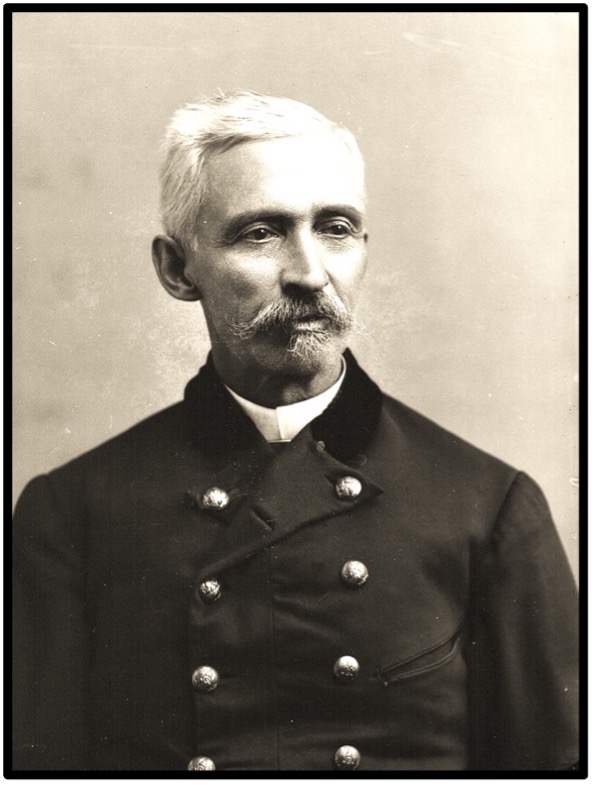
John Hammond (1827 – 1889) of Crown Point: RPI Graduate, a Gold Rush ‘49er and Civil War Veteran. A Pivotal Leader in the Development of Iron Manufacture in the Adirondacks and Crown Point’s Philanthropist and Politician.
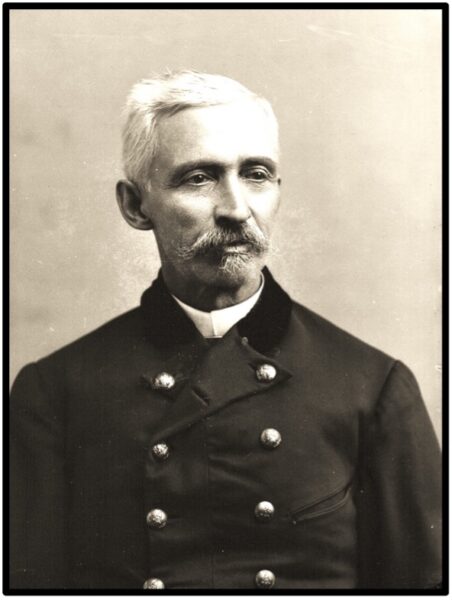
John Hammond
John Hammond was born at his family’s home in Crown Point on August 17th, 1827. His father’s family came from Lavenham in Suffolk County, England to Hingham, Plymouth County, Massachusetts in 1636. His ancestors fought in both the French and Indian Wars and the American Revolution. His father, Charles F. Hammond, was born in Pittsfield, Massachusetts and early in adult life moved to Crown Point, where he became a prominent owner and operator of lumber and iron businesses. John Hammond’s mother, Jane Renne, was born in Crown Point; her family were among the earliest settlers. John attended public schools in Crown Point, in Panton, Vermont and at St. Albans Academy in St. Albans, finishing his education at Rensselaer Polytechnical Institute in Troy, NY.
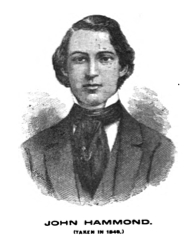
Photo dating 1948, before Hammond left for California.
Hammond was working as a clerk in his family’s Crown Point store, “Hammond & Company” when, in 1848, gold was discovered at Sutter’s Mill, California. Hammond decided to join the ’49 Gold Rush to improve his health, which he described as “delicate”. In his words, “My ambition was to see my country, and I had an inspiration of its magnitude from reading a condensed account of Lewis and Clark’s trip from the Mississippi to the mouth of the Columbia River”. After Hammond’s death, a partial manuscript describing the overland journey was found in his papers, describing in detail the adventures and hardship he endured traveling from the East to Fort Smith on the Arkansas River (the manuscript is available through Google Books, see below). This was just the beginning of the arduous five month journey he and his companions would make across the Great American Desert (now the states of Oklahoma, Texas, New Mexico and Arizona) and across the Sierra Nevada to Los Angles and finally San Francisco. Hammond did not similarly record the details of the rest of the trip but only noted that, with the memory of it recently in mind, he could not imagine ever repeating it.
After three years in California Hammond returned to Crown Point and was, in his own words, “greatly benefited in his health”. Shortly after his return, he married Charlotte Maria Cross and over the next decade they had six children. Hammond helped run his family’s iron ore and lumbering businesses.
As national tensions over slavery led to the outbreak of the Civil War, Hammond, who had learned firsthand the realities of slavery while traveling through Arkansas en route to California, helped raise Company H of the 34th New York Volunteer Infantry. He provided horses for the 5th New York Volunteer Cavalry and was voted their Captain. He proved to be an excellent leader and tactician, earning the respect of both his troops and his commanders. Rising rapidly to the rank of Colonel, he led the 5th New York Cavalry though major conflicts, including the 2nd Battle of Bull Run. Following his heroic leadership during the Battle of Gettysburg, he was promoted to the honorary rank of brevet Brigadier General. Nonetheless, he did not serve through the end of the war but, for family reasons, returned to Crown Point at the end of his three year enlistment in 1864.
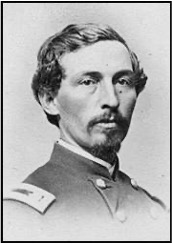
John Hammond, Civil War Years
Over the next 25 years he grew his family’s businesses. He consolidated the iron mining companies in the area into the Crown Point Iron Company, expanding and upgrading its facilities to match the best in the country. In 1872 he oversaw the construction of a massive double blast furnace, costing nearly half a million dollars and considered among the most advanced of the time. The first Bessemer steel produced in the US was made from Crown Point pig iron. He managed the construction of a 13 mile narrow gauge railway for the transport of iron ore from the mines in Hammondville to Lake Champlain. Later he was president of Whitehall and Plattsburgh Railroad, further expanding regional transportation networks.
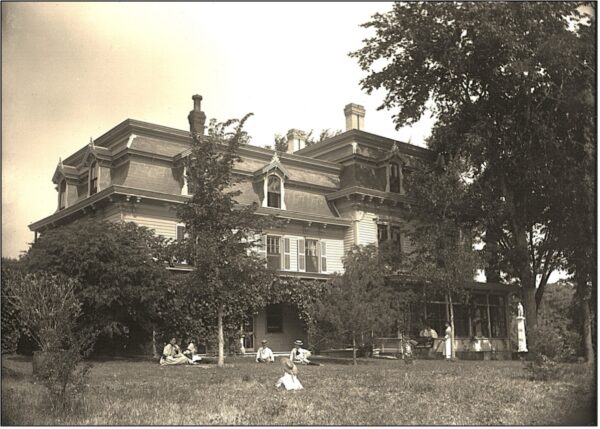
John Hammond’s home in Crown Point
Hammond also became an important civic leader in the years following the Civil War. He was elected as one of three State Prison Inspectors in 1867, serving two years in that position. He brought his experiences leading, managing and discipling men during the Civil War and in the mining business to the 1860’s prison reform efforts that focused on rehabilitating, rather than punishing offenders. In 1879 he was elected as a Republican to the US Congress, representing New York’s 18th district and serving two terms. He was a member of the Republican National Convention in Philadelphia which nominated Ulyssis S. Grant for a second term as president in 1872.
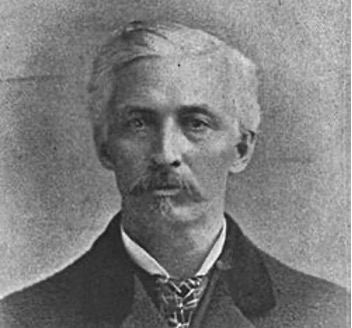
John Hammond, member of the US House of Representatives
Among his many philanthropic contributions to his hometown and surrounding areas, he funded Crown Point’s public library (Hammond Library) and its Congregational Church. John Hammond died on May 29, 1889, and is buried in Forest Dale Cemetery in Crown Point. On the green in Crown Point is a granite obelisk dedicated to Hammond’s beloved Morgan horse, Pink, which carried him throughout his service in the Civil War.
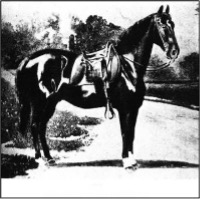
PINK
Died Sunday, May 25 1886 – Aged thirty years
This horse carried his master twenty-five years. Was never known to show fatigue while other horses of cavalry and flying artillery were dying from want of food and exhaustion. He was present in eighty-eight skirmishes, and thirty-four battles, notably, Winchester, Orange Courthouse, Second Bull Run, Hanover, Pennsylvania, Brandy Plains, Buckland Mills, The Wilderness, Spotsylvania Courthouse, North Anna, Ashland, White Oak Swamp, Reams Station.
[Inscription on the monument erected at Crown Point, N.Y.]
If you would like to read more of John Hammond’s life and career, you can download the book, John Hammond: Died May 29, 1889, at His Home, Crown Point, N.Y. Chicago, IL: P. F. Pettibone & Co. 1890 from Google Books. To read more about his horse, Pink, download the article “Morgan Horses in the Civil War”, by Charles L. Hammond, in Vol II, No. 1 of the Vermont Horse and Bridle Trail Bulletin.